Duncan Clarke, Acacia tour leader sets off for his adventure to climb to the ‘Roof of Africa’ – Mount Kilimanjaro. Over the next few weeks stay tuned for his four part blog as he gets ready for his hike, slowly starts the hike and the views around, the long hard miles he treks and the finishing touches as he reaches the summit at 5895 metres.
Part 1 – Ready? Let’s get set….
After 19 months on the road for Acacia I finally bought myself a Tanzania soccer shirt. Not because I want to look like half the other Mzungus (White people) in Arusha, Dar Es Salaam and Zanzibar, not because I had suddenly become a die-hard Tanzania supporter, but because I was about to hike up Africa’s highest mountain – Kilimanjaro – and for this I’d be needing a quick dry shirt. When you have people falling over each other to sell you one of these for under $10US it makes equipping yourself for outdoor activities as easy as buying a coke. If only people were as eager to give me an all season sleeping bag, some waterproof gloves and some hiking poles for the same dirt cheap prices!
Climbing Kili has been on my radar since arriving in Africa in April 2012. I’ve always been keen on hiking and have done some great multi day trips in various places around the world. From the Tararua ranges back home in New Zealand to Torres Del Paine National Park in Patagonian Chile, I’ve seen some stunning places and done some reasonably challenging hikes over the years. When you hear descriptions like “the highest mountain in the world which can be climbed without technical equipment or experience”, who wouldn’t want to put on their boots and have a crack? I know I did.
When I first started working for Acacia I visited Meserani Snake Park – one of Africa’s best known and loved Overland campsites, just outside of Arusha, Tanzania. I got my hands on one of their T shirts which says: “If you can’t climb it, drink it. (Kilimanjaro Premium Lager)”.I told myself that one day I would have a photo of myself wearing that T shirt at the summit of Kilimanjaro.
At 5895 metres above sea level, there are not many mountains which come close to challenging Kili as Africa’s highest peak. The closest is Mount Kenya at 5199m. It looms over the town of Moshi and is one of the most distinguishable natural features on the African continent. The top few hundred metres are adorned with glaciers and after rainfall, a dusting of snow.
On Acacia’s East African trips we pass by Kili on the main highway. While the mountain is clearly visible on a cloudless day, it is very common for the upper reaches to be obscured by cloud. I have driven past Kili about 25 times in the past year and a half but before this hike I had only had a clear view of the summit three times. I love mountain scenery and each time we would head towards Moshi I‘d get excited and hope that I’d get to admire the summit but would normally be disappointed- not only for myself, but for my passengers, who probably wouldn’t get another chance to see it.
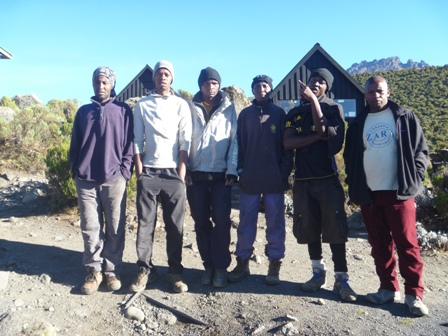
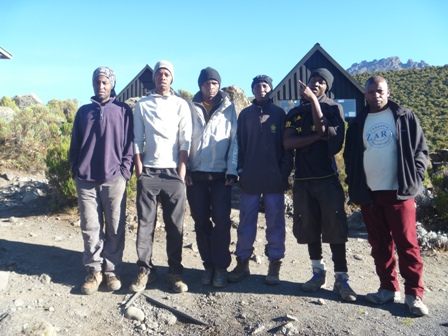
After arming myself with my Tanzania shirt and a stash of high energy snacks, I made my way to Moshi. My trip would start from the Springlands Hotel, just outside of the town. I checked in and had a quick meeting with the staff. I met Mzui, my head guide. With 12 years experience climbing Kili and more than 100 successful summit attempts, this would be the guy who would get me to where I wanted to be. I was informed there would be a crew of six people taking care of me- just me! I was a bit surprised by this at first, but when all the logistics are taken into account, and the fact that every single thing used on the trip has to be carried up the mountain, it starts to make some sense. There would be Mzui- head guide, Lucas- Chef, Saleem- Waiter, Amri, Chombo and Saidi- porters.
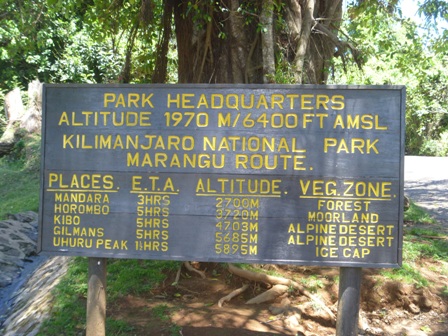
There are various routes up and down Kili. The one I would attempt is called the Marangu Route. It starts near the village of Marangu. It’s known as the “Coca Cola” Route because it’s the most popular route for tourists to take. It’s the shortest and most developed path to the summit, with hut accommodation along the way.
During my time in Africa I have met a lot of people who have climbed, or at least tried to climb Kili. I have picked a lot of people’s brains and have had mixed descriptions of the climb. One guy – a marathon runner- said “it wasn’t all that hard really” another said “by far the hardest thing I’ve ever done”. It probably depends on a lot of things.
Acclimatisation to altitude is a big factor. The ascent is done at a very slow pace but as altitude increases, the air becomes thinner and thinner. What would be a casual stroll at sea level becomes a strain on the respiratory system above 3000metres. The effects vary from person to person. How well you cope is mostly to do with genetics. Some people struggle with light exercise at 2700m. Others don’t feel anything unusual until much higher. Headaches, nausea, vomiting and unconsciousness can follow if a person ignores the early symptoms. An excursion to 5895m- the level of Uhuru Peak, Kili’s highest point- can have serious, even fatal consequences. It is not uncommon for people to suffer acute mountain sickness and be evacuated.
There are a few ways to combat this:
Physical fitness is probably the most important. Walking uphill at 5000m is like running at sea level. An attempt on the summit involves several hours of uphill walking at altitudes approaching and exceeding 5000m. If you don’t want to be stopping to rest every 2 minutes then you need to be fit.
There are medications available to prevent altitude sickness. I took Diamox which I got from my travel doctor before coming to Africa.
Drink LOTS of water. At least three litres per day. It’s going to make you pee a lot but that’s a small price to pay to get to the top.
Of all the people I have talked to about climbing the mountain, several of them said they wouldn’t have got to the top without their guide. When the effects of altitude kick in and the legs feel like they can’t give any more, some people need a real psychological boost from someone who has been there dozens of times before to get them through. I decided from the outset that I would follow my guide’s advice, no matter what. One of the first things Mzui said to me when we met was:
“You want to get to Uhuru peak, you listen to me”.
At the Springlands Hotel I was able to rent the last few items of equipment I would need for the trek. An all seasons sleeping bag is important as I would be sleeping at altitudes of up to 4700m. I met some guys recently who were very cold at night without a good sack. Waterproof gloves with a warm inner lining- essential for the summit day. Hiking poles- very helpful for that last push to Uhuru peak. I put what I needed in a day pack to carry while hiking, the rest of my gear for the hike in my big pack for the porters to carry, and everything I didn’t need went into the storage room at the Springlands Hotel.
On our departure day we loaded into the vehicle and were on our way by 9am. From Moshi we headed through the village of Marangu and up to Marangu gate, where the Kilimanjaro National Park HQ is located. There was a bit of paperwork to get through and then we started hiking about midday.
Stay tuned for the next blog as he starts his trek up this magnificent mountain and what he sees on route.
Written and images by: Duncan Clarke, Acacia Africa Tour Leader