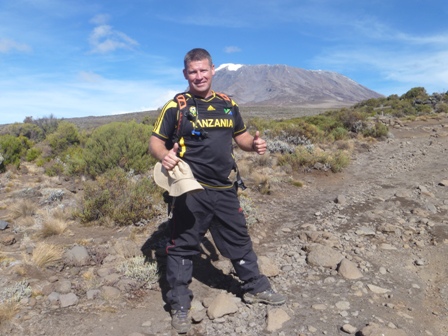
Duncan Clarke, Acacia tour leader sets off for his adventure to climb to the ‘Roof of Africa’ – Mount Kilimanjaro. Over the next few weeks stay tuned for his story as he slowly starts the hike and the views around, the long hard miles he treks and the finishing touches as he reaches the summit at 5895 metres.
Part 2 – Pole Pole, slowly does it!
Day one involved hiking from Marangu gate to Mandara hut. It’s a distance of about 7km going from 1970m to 2720m above sea level. A sign at the start says it takes three hours. The Chef, Waiter and Porters would load up and walk ahead of us each day. Mzui and I would walk together the whole time.
There are various types of vegetation on the way up the mountain. In this lower section the track passes through Montane Forest. For the most part we were walking under the forest canopy so it was nice and cool. Mzui told me about some of the animals which could be found here. Blue Monkeys are common, as are Vervet Monkeys, Dikdiks (a very small antelope), and there are plenty of birds around too. After about 90 minutes walking at a very relaxed pace we arrived at the picnic spot. We got out our packed lunch, sat down and had a bite to eat.
We continued on our way and shortly afterwards saw a family of Blue Monkeys jumping around in the trees. They weren’t too shy and got quite close to us. As we walked up the trail another group of hikers approached us from the rear. They were a German brother and sister who were doing the same trip as me, but with another company. They passed us and I remembered thinking that they were walking at the kind of pace I would normally hike at. Everybody I had spoken to about Kili told me the guides were constantly reminding them of the need to go “pole pole”- Swahili for “slowly”.
Taking it easy on the ascent means your body has more time to adjust to the altitude. Besides, when you only have a three hour hike ahead, why rush?
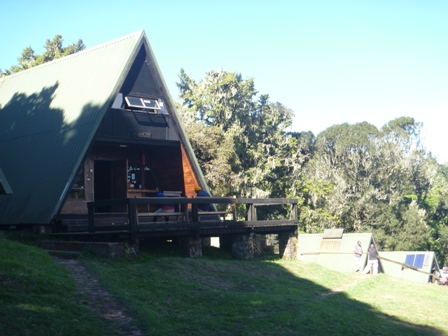
We arrived at Mandara hut about 3.30pm. I was shown to my hut which had four bunks in it.
Because November is low season and there weren’t many people around, I had the hut to myself. Saleem, my waiter, brought me some warm water to have a wash and then told me there would be tea and popcorn in the dining hut. After having a snack, Mzui told me we could go for a walk up to a small crater just 20 minutes up the track. It’s a good idea when ascending to sleep at a slightly lower altitude than what you have reached during the day. So we went up the trail a little more, getting some nice views of Mawenzi- Kili’s second highest peak- and down into the valley below.
After heading back to camp we had dinner in the dining hall and had a chance to chat to some of the other groups at the hut. There were the German brother and sister, four Danish girls, a Swedish mother and daughter and three Canadian friends.
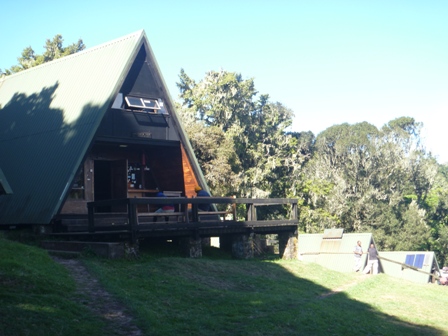
Day two was a bit of a longer day. We would hike from Mandara hut to Horombo hut. A distance of about 11km ascending from 2720m to 3780m. We expect to hike for about five hours. Shortly after leaving Mandara the vegetation started to change. We left behind the montane forest and entered the heath and moorland zone. Here the plants are smaller and very shrub like. There is no longer a canopy for shade so we were more exposed to the elements. Luckily it was a nice day with a cool breeze. Again we took it at a very slow pace to adjust to the altitude. This was becoming more important on day two as we were now approaching heights where the effects of the thinner air would become noticeable. We stopped at another picnic area for lunch before hiking the last hour and a half to the hut.
Horombo hut is the largest group of huts on the Marangu Route. This is because hikers stay there on the way up and the way down. I followed the same routine as the day before. Checked into my hut, warm water for washing up, milo and popcorn. There was tea and coffee available, which I normally enjoy, but I read somewhere that these are diuretics which can make the effects of altitude come on stronger, so I decided to stick to milo (a chocolate/malt hot drink), at least until after reaching the summit.

There was no plan to walk any higher this afternoon to aid acclimatisation but there was still plenty of the day left and I had energy to burn so I took a walk up the track just for 10 minutes or so. On my way I started to see people coming down the track who had made the attempt on the summit that morning. Some looked pretty cheerful, others appeared very tired or just miserable. I started trying to guess by people’s body language whether they had reached Uhuru peak or not.
During the afternoon cloud had started to roll in and obscure any views of the mountain above or the hills below. The rest of the world had disappeared.
Written and images by: Duncan Clarke, Acacia Africa Tour Leader