Duncan Clarke, Acacia tour leader sets off for his adventure to climb to the ‘Roof of Africa’ – Mount Kilimanjaro. Over the next few weeks stay tuned for his story as he tackles the long hard miles he treks and the finishing touches as he reaches the summit at 5895 metres.
Part 3 – The long, hard miles…
The hiking so far hadn’t been too challenging but I knew the summit day wouldn’t be as easy. I had spent a fair bit of time between 3000 and 4000m before while working in South America. I had made short visits to 5000m- sometimes driving and once hiking. When I had hiked to 5000m I struggled to breathe and felt awful. I used to smoke back then and hadn’t done much exercise. Leading up to my Kili trek I had been doing day hikes when possible and running between 5 and 10km a couple of times per week. While I could have done more, I was definitely in better shape to tackle Kili than I had been in the Andes. On that second night I was in very good spirits and had the feeling that only altitude sickness could stop me from reaching the top.
At 6am the following day I got up and saw blue sky through the window. I went outside and saw that all the cloud from the night before had blown away to leave a beautiful clear day. Moshi town was clearly visible way down in the distance. Looking up I could see the ice capped summit staring back at me. As if I wasn’t already in a good enough mood, now I was feeling like a little kid. I couldn’t wait to get going.
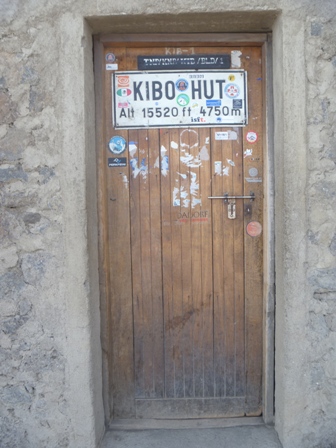
The third day of hiking would take us from Horombo hut to Kibo hut- the base from where we would make our summit attempt. It was a distance of about 9km ascending from 3780m to 4750m. The first half of the hike was a bit steep. At one point I started feeling pressure behind my eyes and in my forehead. I had to slow down even more and increase my water intake. I had been drinking three litres of water per day but started drinking even more. It seemed to work as my headache went away.
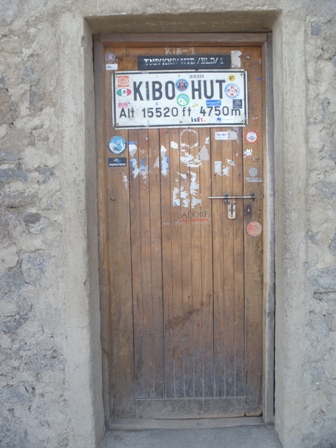
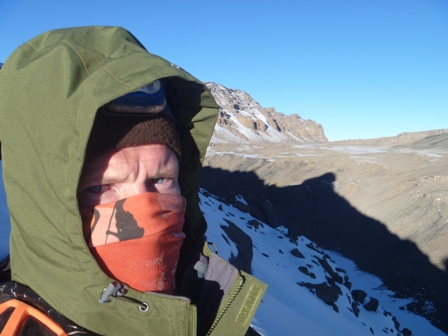
As we came up and over a ridge the vegetation changed again, in fact, it all but disappeared. We were now entering the alpine desert. It was a barren landscape which had very little life but a bizarre beauty about it nonetheless. We had superb views of both Kibo (the crater which Uhuru peak is on top of) and Mawenzi. The track became more gradual in it’s incline now. We made our way onwards and upwards towards Kibo hut, arriving just after midday. We had a hot lunch of chicken and chips, served with a smile as always by my awesome waiter Saleem. After this Mzui encouraged me to get some sleep as we had a big night and day of hiking ahead. A little later in the afternoon a group of three Americans arrived at the hut and came to share my room. They had come up from Horombo as well and were saying how difficult they had found the day’s hiking.
We were all woken up for dinner around 5.30pm then again told to get some sleep. The Americans would start their summit attempt at 11pm, mine would start at midnight. I went outside and took a few photos. It was a really nice evening with the only clouds about 2000m below us. The German brother commented about how we had perfect conditions for our hike; I’ve never been one to count my chickens before they hatch. We had no way of knowing what the weather would do between that time and when we got up the top. I just told him I’d be happy if the conditions stayed the same.
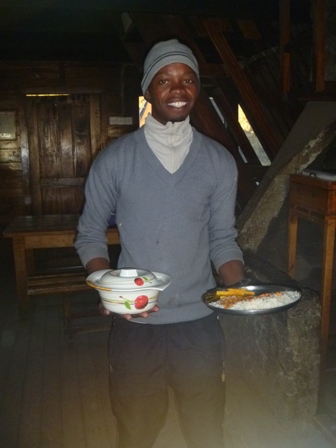
Saleem woke me up at 11pm, just as the Americans were leaving. He brought me tea and biscuits while I got into my climbing gear. I had a cup of milo and although I wasn’t hungry, I made myself eatsome muesli bars and chocolate. I knew I’d need the energy. The hike today would take us up the steep side of Kibo crater. To get to Gilman’s point at the edge of the crater normally takes 5 hours. After that it’s about 2 hours around the crater edge to Uhuru peak- the roof of Africa.
We started off at midnight, me following Mzui, both of us with headlamps lighting the path ahead. I could see a few other groups of lights up ahead of us. Mzui kept the same steady pace we had been using the previous day and I was very comfortable moving at this speed. We found ourselves gaining on the groups ahead and within an hour we had passed the three Americans already. They were moving at a real snail’s pace. After about two hours we had a break. I use a camelback drinking system and the nozzle leaks a little bit. I noticed at this stop that the water which had leaked on my jacket was starting to freeze. I hadn’t realised how cold it was because we had been keeping ourselves warm with the physical activity.
The track up the side of the crater went in a zig-zag pattern. To walk up it directly would be extremely steep. We zigged and zagged over and over and over. Mzui took slow, long steps. I preferred to take very short steps more often. I was using my hiking poles for this last day and got myself into a rhythm of putting my poles ahead of me and taking four steps to put myself ahead of them. I repeated this over and over and over. Occasionally I’d look back down and see the other groups’ lights bobbing away below us. I could also see lights from towns in the distance, some of which were on the Kenyan side of the mountain. The peak of Mawenzi was easily recognisable, although it’s summit was now below the level we were at.
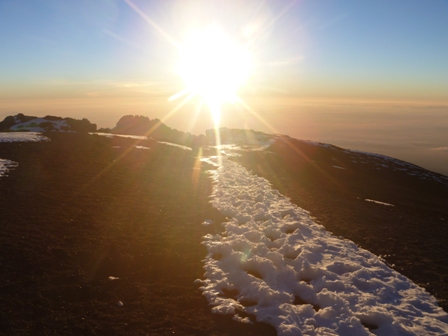
I took an occasional break to drink water. Normally I would drink on the move but I was wearing mittens which made it hard to open the valve on my Camelback. Every now and then Mzui would look back and say “you OK my brother?” I’d always tell him I was fine. My legs were really starting to burn after climbing for about three and a half hours but I knew we were making good progress and if we kept going we should be at the crater rim before too much longer. We clambered over a rocky section and I started to notice that I could see more stars where the edge of the crater had been above us. A few minutes later Mzui called back to me “Congratulations brother, welcome to Gilman’s point.” We had reached the edge of the crater and I knew the hardest part of the climb was over. There was the sign welcoming us to Gilman’s point. Looking down where we had come from we could still see the lights of the other groups. Mzui yelled at the top of his lungs:
“POA KACHIZI KAMA NDIZI!” – (Cool, Crazy like a Banana!) A Swahili phrase which doesn’t really make any sense but has a nice ring to it.
After a few obligatory photos with the Gilman’s point sign, I went to take a drink from my camelback and found that that water had completely frozen in the tube. I took the nozzle off and broke up the ice and was able to get some water. I checked my watch and saw that it was 4.12am. Just over four hours to reach the crater rim! I was pretty chuffed with my effort and although I was tired, I wasn’t feeling sick, didn’t have a headache and was still raring to go on to Uhuru peak.
Written and images by: Duncan Clarke – Acacia Africa Tour Leader